Spanish Civil War
For Whom the Bell TollsThe Spanish Civil War is the historical conflict that gives the novel its immediate stakes and shapes nearly every choice its characters face. Through Robert Jordan’s mission to destroy a bridge in coordination with an uncertain offensive, the war appears not as an abstract contest between armies but as an unstable system of orders, roads, weapons, trust, and delayed information. At the same time, the conflict presses a moral question into the lives of those fighting it: how can people defend a political cause while resisting the violence that its defense requires?
Identity and Setting
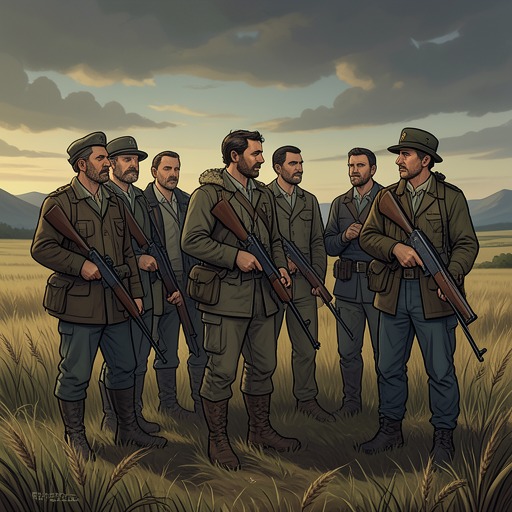
The book’s introductory account places the story in the Spanish Civil War and identifies Robert Jordan as a young American in the International Brigades, attached to an antifascist guerrilla unit in the mountains of Spain. Its stated concerns—loyalty and courage, love and defeat, and the tragic death of an ideal—locate the war at once in military events and in the human relationships those events imperil. The novel’s focus is not limited to the battlefield: the conflict also shapes memory, political belief, responsibility, and the possibility of returning to ordinary life.
Jordan enters the mountain operation with experience behind enemy lines and confidence in his technical work. He is hungry and worried, but his initial anxiety is not simply fear of capture. He knows the difficulty lies in deciding whom to trust and in taking responsibility for that decision. He trusts Anselmo as a guide, whose skill in the mountains has already been demonstrated, while reserving judgment about the old man’s decisions. Jordan considers the bridge itself a familiar engineering problem: he has demolished bridges of different sizes and constructions, and has brought enough explosive and equipment for the task. The war therefore joins specialized competence to a more uncertain human and political landscape.
The Bridge Mission and the Command System
The bridge demolition is governed by a larger attack whose timing and success are not fully within the attackers’ control. Golz orders that the bridge be blown only after the offensive begins, so that reinforcements cannot travel along the road. The timing matters: destroying the bridge prematurely would fail to serve the operation’s purpose, while delay could leave the road open. Yet Golz explains that an attack is vulnerable to interference, changes of order, inadequate artillery, and postponement. He can make an attack, but does not command every resource it requires or possess sole authority to cancel it. Jordan’s local mission is thus tied to a command structure he cannot personally stabilize.
The physical bridge makes the strategic problem concrete. Jordan and Anselmo approach it through the trees until it lies about fifty yards away: a single-span steel structure with a sentry box at either end, wide enough for two motor cars, crossing a deep gorge above the watercourse. Jordan studies its construction and sketches where charges should be placed to cut the support and drop part of the span. He considers two methods: several smaller charges braced to explode together, or two large charges placed opposite each other. His careful technical assessment stands in contrast to the uncertain timing of the offensive. The demolition can be planned scientifically; the conditions that make it useful cannot be guaranteed in the same way.
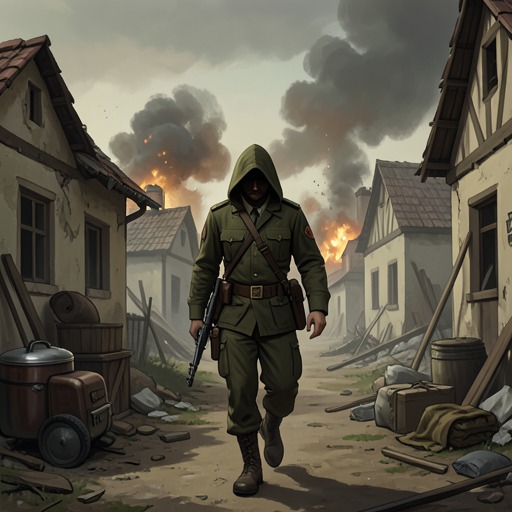
The resistance group’s resources further expose the distance between a plan and its execution. El Sordo arrives with dynamite, saying that he has sixty sticks and can bring four more, but does not know its percentage. At the bridge, Anselmo passes down oblong blocks of explosive while Jordan places, braces, wedges, and lashes them against the steel. The work must continue as firing and grenades sound elsewhere on the road and firing continues at the upper post. Jordan briefly wonders what has struck the people below, then has to return to the charge he is fastening. A safe-conduct paper also proves subordinate to immediate road control: a driver demands his pass while trying to move a wrecked truck, but the control man dismisses the paper and directs him to reposition the vehicle. In this war, papers, plans, and orders operate within the pressure of immediate circumstances rather than above them.
Political Belief and Uneasy Solidarity
The conflict’s political commitments are inherited as well as chosen. Pilar says she has been a Republican for twenty years. Maria says that her father was a Republican all his life and was shot for it; Jordan replies that his father and grandfather were Republicans too. This exchange connects the present struggle to family memory, while also showing that the characters’ connection to the Republic has different histories and forms. The cause is not merely an instruction received for one operation: it reaches backward into political identity and the losses that have marked it.
Jordan also understands his allegiance as a commitment to people’s right to govern themselves. In a searching internal dialogue, he acknowledges killing more than twenty people whose deaths he can identify, while distinguishing the two prisoners he shot at Usera as the only people he is certain were fascists. He admits that train demolitions killed many more, though he cannot know how many. He insists that the cause is right, but refuses to make killing itself an article of faith: he can regard it as necessary without believing in it. The distinction does not resolve his responsibility. Instead, the passage makes political conviction answerable to the actual consequences of action.
The novel gives the same problem a different emphasis through Anselmo. He considers killing a man sinful, including the killing of fascists whom the guerrillas believe they must oppose. He rejects the notion that violence teaches an enemy anything: killing, he reasons, leaves hatred to be inherited, while imprisonment also breeds hatred. His alternative is that opponents should work as the guerrillas work, live and eat as they do, and learn through shared labor. The difference between Anselmo and Jordan is not whether the war requires action; Anselmo accepts that he will kill again. It is whether necessity can absolve the act, and whether a just political outcome can be secured by means Anselmo regards as morally damaging.
When left alone near the sawmill in falling snow, Anselmo extends that conflict beyond his own actions. He watches the fascists inside and thinks of them as poor men like himself, not naturally enemies but men separated by orders. He knows the men at that post are Galicians and believes they cannot desert without putting their families at risk. He anticipates killing them the following night, yet resists the ease with which a military label might erase their humanity. The scene makes the war’s divisions at once real and morally insufficient: orders place armed men on opposite sides, but do not make those men wholly different kinds of people.
Violence, Memory, and the Cost of Fighting
Anselmo’s doubts return whenever he is alone for long. He wonders whether those who survive the war will need a shared penance for killing: if religion no longer provides it, he thinks, some civic form of atonement must be found so that people can be cleansed of the violence and recover a human basis for living. His concern is not limited to battlefield deaths. He fears that killing will brutalize those who do it, even when they know it is necessary. War, in this view, threatens the moral capacity of the people who mean to resist it as well as the lives of their opponents.
Jordan’s reflection on the conflict likewise turns on what fighting does to a person. He recalls how the International Brigade headquarters at Velázquez 63 and the former Fifth Regiment headquarters could make service feel like a crusade: a demanding brotherhood and a duty toward the oppressed, strong enough to make personal death seem unimportant except insofar as it would interrupt the work. He contrasts that early sense of consecration with the loss of purity among those who survived and became effective fighters. The contrast does not deny the sincerity of the original commitment. It shows how prolonged participation changes the meaning of a cause: the ideal may remain, but the practices necessary to defend it leave their mark.
That tension also governs Jordan’s practical relationship with the guerrilla group. Alone by the horses, he weighs the possibility that the others expected him to kill Pablo, whose presence threatens the group’s discipline. He decides that killing a man with whom he must continue working would be a grave risk, and that the consequences would be difficult to judge. He believes the group’s organization depends heavily on Pilar and considers whether Anselmo, Agustín, or Pilar might act instead; none of these possibilities gives him a simple solution. The war’s demands cannot be reduced to obedience to the immediate mission, because Jordan must also consider how a decision will affect the people and organization on which the mission depends.
Offensive, Defeat, and Narrative Significance
As the planned attack approaches, Jordan recognizes that Golz can launch it but may not be able to cancel it. The necessary permission must come from Madrid, where officials may not be reached in time. Jordan had wanted to warn Golz about preparations made to meet the attack, but movement on the road began only at dark, too late for the information to be sent sooner. He speculates about whether fascist aircraft have revealed those preparations, whether reports of Italian forces indicate a second offensive, and whether the enemy might advance toward Guadalajara using a different plan. These thoughts convey not omniscient military explanation but the uncertainty faced by a participant who has to act with incomplete information and cannot tell which possibility is real.
The war’s consequences reach beyond the battlefield schedule into Jordan’s imagined future. Before meeting the guerrillas, he had expected either to return to the lines after the bridge was blown or not to return. If he did get back, he hoped to ask for a few days in Madrid: a room, a hot bath, books, absinthe, and a meal with Karkov at Gaylord’s Hotel. In retrospect, the ordinary itinerary belongs to a simpler world that the operation has displaced. Jordan has met people whose lives now matter to him, and the bridge mission is no longer only an assignment with a defined endpoint.
The final predicament preserves the same collision between organized war and individual choice. After the demolition, Jordan waits for the enemy while pain from his injured leg worsens. He considers what he will do if captured or rendered unable to resist, and wishes the opposing soldiers would arrive before he has to decide. His mind shifts between the practical failure of the operation’s arrangements and the personal cost that now falls on him. The war offers no clean separation between tactical outcome and private suffering; the very mission through which Jordan has served his cause leaves him facing its consequences alone.
The Spanish Civil War therefore functions as both the novel’s political setting and its test of moral language. It gives Jordan a cause he regards as just, but denies him control over the command system, the enemy’s movements, or the consequences of violence. It gives Anselmo a duty to fight while leaving him unable to regard killing as anything but a sin requiring atonement. By placing technical plans beside uncertain intelligence, inherited belief beside personal loss, and military necessity beside individual conscience, the novel makes loyalty meaningful without pretending that loyalty can make war morally simple.